
NFC (Near Field Communication)
NFC (Near Field Communication) is a contactless technology that allows the exchange of data at short distances (less than 10 cm) between compatible devices. Used for mobile payments, identification and IoT, it is based on magnetic induction communication, offering speed, security and simplicity in digital interactions..
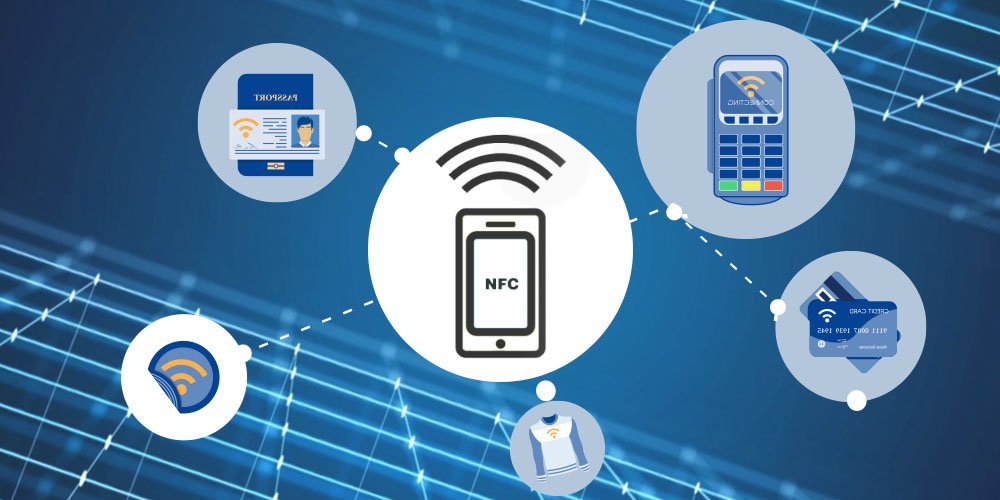
NFC technology is ubiquitous in our daily lives, enabling fast and secure interactions between devices. It is used for mobile payments, access cards, and much more. Here is an in-depth exploration of this technology and its applications.
NFC could be used to secure access to buildings or vehicles by replacing physical keys with smartphones or NFC cards.
Common Applications of NFC Technology)
- Contactless payments : With solutions like Apple Pay, Google Pay, or Samsung Pay, NFC is at the heart of mobile payments, enabling fast and secure transactions.
- E-tickets and public transport : Transport cards and e-tickets use NFC to easily access public transport without having to take out a physical ticket.
- Access control : Many businesses and institutions use NFC cards to access secure areas (buildings, parking lots) without the need for traditional keys.
- Smart labels and connected objects: Consumer products can be equipped with NFC chips to provide additional information about a product, or even to activate features on devices like Bluetooth speakers or smartphones.
- File sharing: Exchanging data via NFC between smartphones is also popular. This allows, for example, to transfer photos, contacts or files simply by bringing the two devices close together.
How does NFC technology work?
The principle of NFC is based on the transmission of information between two devices via radio waves. When an NFC-equipped device (for example, a smartphone) is placed near another device (such as a payment terminal), they exchange data using a process of electromagnetic induction.
NFC can work in three ways:
- Reader mode : The device interacts with an NFC "card" (such as a payment or identification card).
- Card mode : The device acts as an NFC card to send information to another reader (e.g. a smartphone acting as a bank card).
- Peer-to-peer mode : Two devices can exchange information directly with each other (e.g. sending contacts from one phone to another).
Advantages of NFC technology
NFC can work in three ways:
- Speed : NFC transactions are completed in seconds.
- Simplicity : No need for an Internet connection or complex networks.
- Security : Data exchanged via NFC is protected by encryption protocols.
- Convenience : Ease of use, such as in payments or access management, makes the technology very popular.
Limitations of NFC
- Limited range: The communication range is limited, usually to a few centimeters. This means that it is difficult to transfer information over long distances.
- Possible interference: Since NFC uses radio waves, other devices or radio signals can sometimes cause interference.
Conclusion
NFC technology is a great example of innovation in short-range wireless communication. Its effectiveness in mobile payments, access control, and other everyday applications has profoundly changed the way we interact with our environment. Although the technology has some limitations, its advantages make it a key tool for many industries.